
That Frustrating Moment When Your Garage Door Won't Stay Closed
You press the button on your garage door remote, watch the door glide downward, and then — just inches from the floor — it stops and reverses right back up. You try again. Same thing. Maybe you try holding the wall button, and it still won't cooperate.
This is one of the most common garage door complaints we hear from homeowners in Waukesha, and it's especially frustrating during Wisconsin winters when you need that door sealed tight against the cold. The good news is that this problem usually has a straightforward explanation. The better news is that most causes are fixable without replacing the entire door.
Let's walk through the most common reasons your garage door reverses before reaching the floor and what you can do about each one.
1. Misaligned or Dirty Safety Sensors
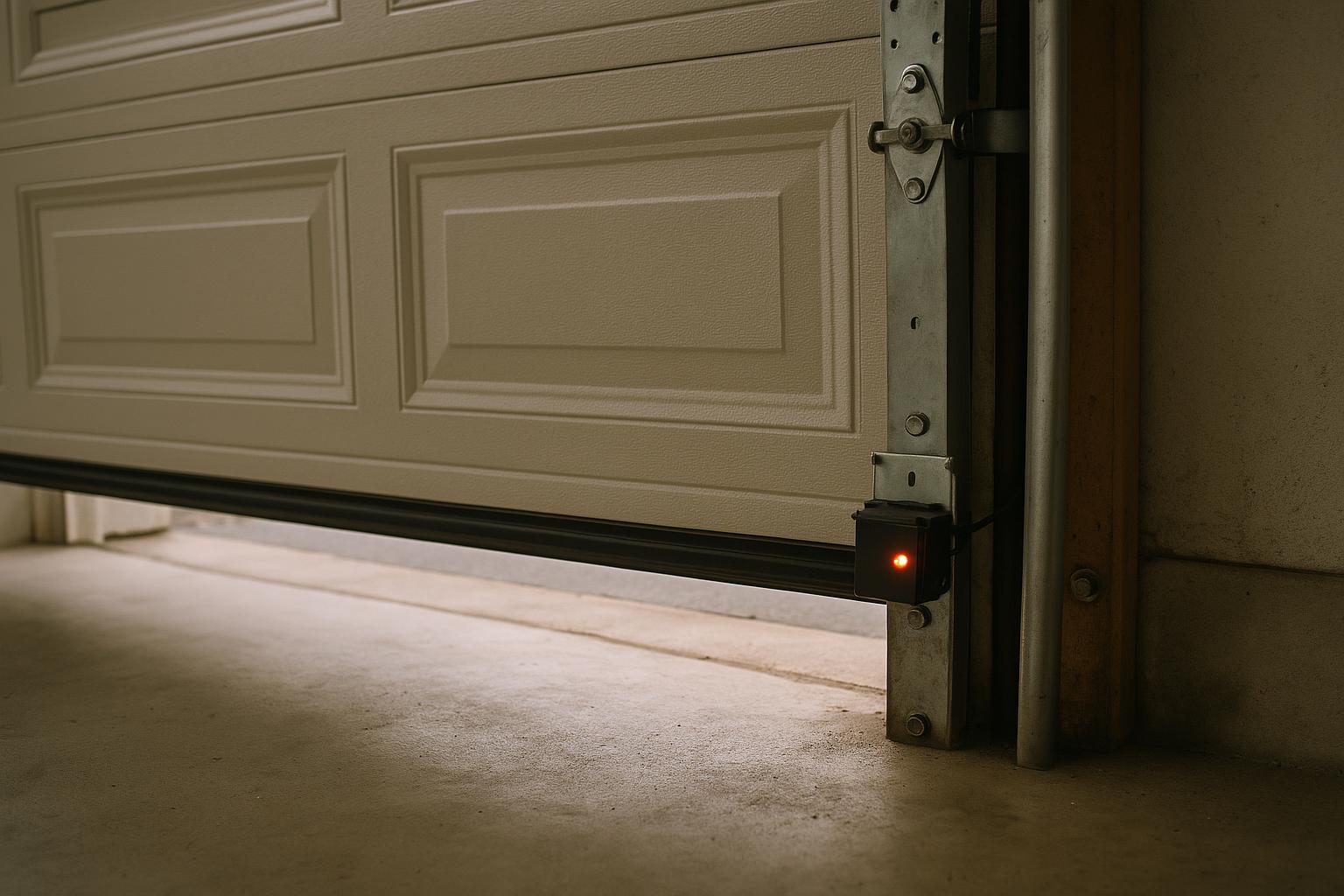
This is the number one cause of a garage door that reverses before closing completely. Every garage door opener manufactured after 1993 is required to have photo-eye safety sensors mounted near the bottom of the door tracks, about six inches off the ground. These sensors send an invisible beam across the doorway, and if anything breaks that beam — a bike, a trash can, a leaf, or even a cobweb — the door will reverse as a safety precaution.
Here's what to check:
- Obstruction in the path: Look for anything between the two sensors, even something small. Remove any objects and try again.
- Dirty lenses: Wipe the sensor lenses with a soft cloth. Dust, dirt, and spider webs accumulate quickly, especially in garages that see a lot of use.
- Misalignment: Each sensor has a small LED light. If one is blinking instead of glowing steadily, the sensors are likely out of alignment. Gently adjust the sensor bracket until both lights are solid.
- Sun interference: In certain seasons, direct sunlight hitting a sensor can overwhelm the infrared beam. A small shade or cardboard tube around the sensor can solve this.
If you've cleaned and realigned the sensors and the problem persists, the wiring between the sensors and the opener may be damaged, which is something a professional can diagnose quickly.
2. Incorrect Close-Limit Settings
Your garage door opener has close-limit settings that tell the motor exactly how far the door should travel before it's considered fully closed. If these settings are off — even slightly — the opener may interpret the door hitting the ground as an obstruction and trigger the auto-reverse feature.
This commonly happens after a new opener installation, when springs have been replaced, or sometimes when temperature changes cause the metal tracks and door panels to expand or contract. Waukesha homeowners who've dealt with the swing from summer heat to subzero winter temperatures know this all too well.
Adjusting the close-limit switch varies by opener brand and model. Most openers have adjustment screws on the back or side of the motor unit. Small turns make a big difference, so adjust in quarter-turn increments and test the door after each adjustment. If you're not comfortable making this adjustment yourself, it's a quick fix for a garage door technician.
3. Worn or Broken Springs
Garage door springs do the heavy lifting — literally. They counterbalance the weight of the door so the opener motor doesn't have to work as hard. When springs wear out or break, the door becomes significantly heavier, and the opener may struggle to control it on the way down.
Some openers interpret this extra resistance as an obstruction and reverse the door. You might also notice the door closing unevenly, slamming down faster than usual, or the opener motor straining more than normal.
Important safety note: Garage door springs are under extreme tension and can cause serious injury if handled improperly. Spring replacement is not a DIY job. If you suspect your springs are the problem, call a professional. Our team handles spring replacements across Waukesha, Brookfield, New Berlin, and surrounding areas regularly, and we always recommend letting a trained technician handle this repair.
4. Problems with the Tracks or Rollers
If your garage door tracks are bent, misaligned, or clogged with debris, the door can bind or stick as it moves. When the opener senses that extra resistance, it may reverse the door to prevent damage.
Inspect the tracks on both sides of the door:
- Look for visible bends, dents, or gaps between the track and the wall.
- Check that the rollers are moving freely and aren't chipped or worn flat.
- Clear out any debris, leaves, or small objects that may have gotten into the track.
Minor track issues can sometimes be resolved by tightening mounting brackets. However, significantly bent tracks or worn-out rollers should be replaced by a professional to ensure the door operates safely.
5. The Opener's Force Settings Need Adjustment
In addition to limit settings, most garage door openers have force settings that control how much power the motor uses to open and close the door. If the close-force setting is too low, the opener won't push hard enough to fully close the door and will reverse instead.
Like limit adjustments, force settings are typically controlled by screws or dials on the opener unit. Increase the close force in small increments. However, be cautious — setting the force too high can override important safety features. The door should reverse when it encounters a real obstruction, like the safety test where you place a 2x4 flat on the ground under the door.
6. Damaged or Worn Opener Gear
If your garage door opener is more than 10-15 years old, internal components like the drive gear or logic board may be wearing out. A stripped gear can cause the opener to lose its ability to control the door's movement precisely, leading to erratic behavior including unexpected reversals.
You might hear grinding or clicking noises from the opener unit, which is a telltale sign of gear problems. In some cases, replacing the gear is cost-effective. In others, especially with older units, replacing the entire opener makes more sense from both a reliability and energy-efficiency standpoint.
When to Call a Professional
Some of these fixes — cleaning sensors, removing obstructions, and minor adjustments — are well within the ability of most homeowners. But if you've worked through the basics and your garage door still won't close properly, it's time to call in a professional.
Here are signs you should pick up the phone:
- You hear loud banging, grinding, or snapping sounds
- The door is visibly crooked or sagging on one side
- Springs appear stretched, rusted, or broken
- The opener is more than 15 years old and acting erratically
- You've adjusted settings multiple times with no improvement
At Waukesha Garage Door, we diagnose and fix reversing issues every week. Most of the time, we can identify the problem and complete the repair in a single visit. We serve homeowners throughout Waukesha, Pewaukee, Delafield, Mukwonago, and the surrounding area, and we offer emergency service when your garage door problem can't wait.
Don't Ignore a Door That Won't Close
A garage door that reverses before closing isn't just annoying — it's a security risk. An open garage is an invitation for theft, and in Wisconsin's harsh winters, it means cold air flooding into your home and driving up your heating bills. Address the problem promptly, whether it's a quick sensor cleaning or a professional repair, and get your garage door back to doing its job reliably.